A brand becomes stronger when you narrow the focus.
Al Ries and Laura Ries, The 22 Immutable Laws of Branding.
Keeping a brand on course is one of the most critical and difficult challenges executives face. A narrow brand focus will help keep your brand aligned with your...
“I have no special talents. I am only passionately curious.” Albert Einstein
Continuously learning is how you will stay relevant at any level of an organization. Consider stepping outside of your comfort zone, diversifying your areas of knowledge and establishing rituals and habits that support learning.
Lifelong...
“The greatest weapon against stress is our ability to choose one thought over another.”
William James, Philosopher, and Psychologist.
Stress in the workplace can have damaging effects, such as stifling creativity and risk aversion. When we operate under pressure, we shift into survival mode and in this mode of perception, we can have a much harder time thinking creatively and seeing things with a broader, longer-term lens. Similarly, when your associates are stressed, they tend to avoid taking risks and have a hard time thinking creatively, which ultimately affects their potential.
“Would you tell me, please, which way I ought to go from here?”
“That depends a good deal on where you want to get to,” said the Cat.
“I don’t much care where—“ said Alice.
“Then it doesn’t matter which way you go,” said the Cat.
“—so long as I get somewhere,’”Alice added as an explanation.
“Oh, you’re sure to do that,” said the Cat, “if you only walk long enough.”
Lewis Carroll, Alice in Wonderland
Organizations that last know where they’re going. They know how they want people to perceive their business and they know what they want to achieve.
In short, they have a strong vision.
Creating a strong vision is a key to long-term success: it gives you clarity on what you should and shouldn’t do for the continuing health and prosperity of the company.
The vision, however, is only one of the keys to success, you must also have a purpose that drives the vision; and, you must have missions, strategies, and tactics to achieve your vision.
Growth was seen as an endless series of daily choices and decisions in each of which one can choose to go back toward safety or forward toward growth. Growth must be chosen again and again; fear must be overcome again and again.Abraham H. Maslow[1. Abraham H. Maslow, The Psychology of Science: A Reconnaissance, 1966.]
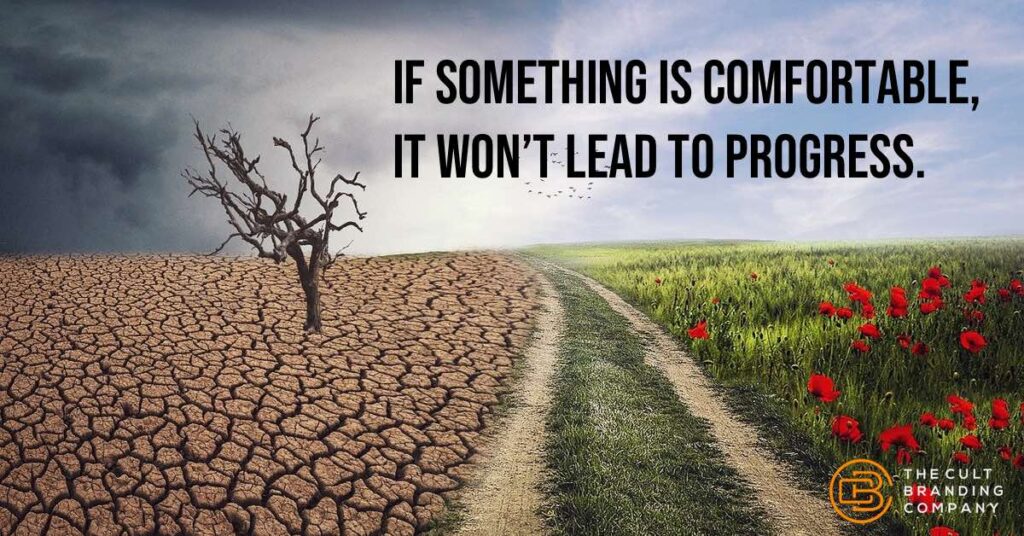
If you’re comfortable, you’re not growing. It’s the uncomfortable things that make us grow.
The same is true of business: companies that embrace discomfort as a regular part of business life are more likely to achieve their goals and move closer and closer to fulfilling their company vision than those that don’t.
Companies that stay comfortable—which feels great in the moment—end up losing in the long run, which doesn’t feel so great.
“Accounting is a department. Marketing isn’t. Marketing is something everyone in your company is doing 24/7/365.”
Jason Fried and David Heinemeier Hansson, Rework
A brand isn’t a name or a logo: it’s the perception people have of your organization. Everything your company and employees do contribute to...
I’m a big fan of the “Freakonomics Radio” podcast. I highly recommend it, in particular an episode titled “What does a CEO actually do?” I love the question because it’s cheeky and because I’m sure many people wonder the same thing but are afraid to...
How do you put archetypes to work?
Start at the center.
The center is unique for each organization.
Your strengths hint at it.
Your organization’s passions point you in the right direction.
The forces that drive your customers to do business with you provide invaluable clues.
This center should be expressed...
When you uncover your business’s archetypes you get to know the DNA of your organization. It is from these fundamental symbolic images that all of the desired behavior for employees and customers spring.
When you know your archetypes, you can ensure consistency in your culture and your...
THE BIG IDEA: There are seven behavioral patterns that characterize distinct leadership styles. Becoming aware of all seven will help inspired leaders identify their strengths and provide additional options based on the context of the situation.
__________________
You don’t have to spend much time in executive meetings...