Author: BJ Bueno

The story customers tell is either that you lived up to your promise or you didn't; you're reliable or your not Your memories are not created through your experiences, rather they are created through the stories you tell yourself and others about those experiences. Joshua Medcalf, Chop Wood Carry Water
Inherent in a brand is the promise to solve a need. Customers try brands because they believe they have the potential to consistently solve a problem they face: they have the potential to make life easier.

the goal isn't to understand them on your terms; it's to understand them on their terms. And he [Carl Jung] pretended, or told it in a way, as if she really had been on the moon and it had happened. And I was very rationalistically trained from school so I said indignantly, “But she imagined to be on the moon, or she dreamt it, but she wasn’t on the moon.” And he looked at me earnestly and said, “Yes she was on the moon.” Marie Louise von Franz, Matter of Heart
What we call something has more power than we realize. It’s because words are more than just a group of symbols that just signify an object or idea: They go further than that to the point that they act as a stand in for that object or idea. In other words, they are a symbolic representation of the object or idea. And, symbols have great power because they act as a host of multiple meanings and layers of meanings within a single structure. The symbolic power of words is why we choose the term Brand Lovers to refer to a company’s most passionate—and highest spending—customers.

Having customers eat together strengthens their ties with each other, and you.

As long as I can remember, I've had an interest in esoteric subcultures. Early on it was comic book collecting, then Magic: The Gathering, then sleight of hand, and then cocktails and bartender culture.

All of these subcultures share a common feature: they have conventions to bring like-minded people together.

The events at these conventions usually aren't the big draw. Instead, it’s meeting friends new and old over drinks at the newest bar that opened or a late night fourth-meal in the back of a Denny’s.

Humans have an innate desire to come together—it is one of our basic needs. And, breaking bread together is one of the strongest ways to form bonds.

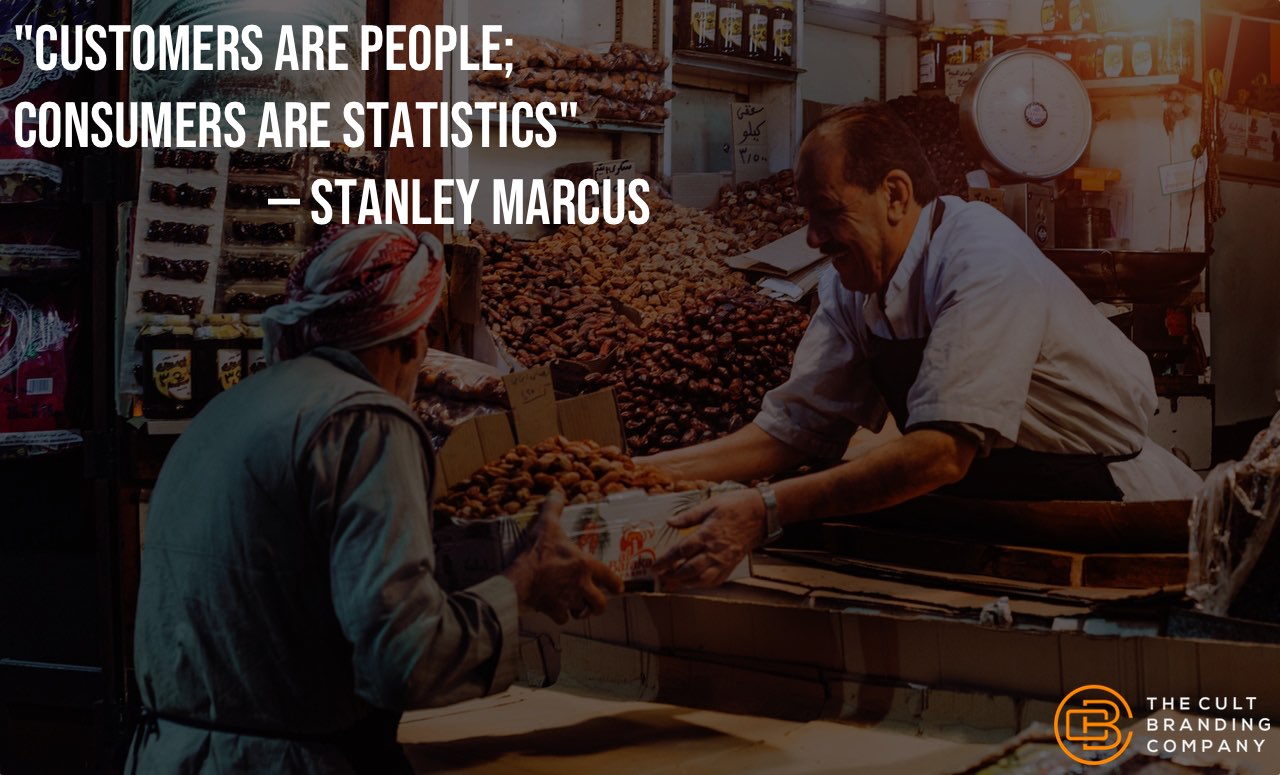
Customers are people; consumers are statistics. Customers are people; consumers are statistics. Stanley Marcus, Quest for the Best

On a recent trip overseas, I was struck at the difference in attitude between airport security in Japan and the US. In Japan, the conveyor belts had a curved design that took up little space and returned the bins automatically, there were only a few employees, and all of the employees were trying to help the customers get through security as pain-free as possible. In the US, there was a new and confusing conveyor belt system that kept backing up, there were more employees at each scanner than I wanted to count, and the TSA employee instructing people how to use the new system kept talking down to customers that didn’t understand what they were supposed to do. The difference between these two experiences, like all customer service experiences, comes down to cultural differences—the culture of the society or the organization.

The reason our stories, messaging and marketing fall flat is that the people we want to serve are not motivated by our need to be seen, to be heard or to close a sale. People—your audience, customers and clients—are motivated by their need to be seen, heard and understood. Bernadette Jiwa, The Right Story
Despite the amount of money companies spend on customer insights, most companies don’t value true insights. Insights should tell you something new; they should change the way you think. Yet, most companies reward predictable results instead of game changers.[1. Gary Klein, Seeing What Others Don’t, 2007.] On average, companies value “insights” that confirm what they’re already doing. At best, they want “insights” that only slightly modify what they’re already doing. But, are these insights really insightful?

Cult Branding was founded on Abraham Maslow’s Hierarchy of Human Needs. Maslow’s hierarchy offers a simple framework for understanding customer behavior: humans have inherent needs that they try to fulfill—consciously or unconsciously—in everything they do. Although Maslow’s hierarchy offers significant explanatory power, it does not provide a complete explanation of brand loyalty. A more complete explanation involves taking a step back from Maslow and understanding how humans react when something happens to them.