Fairy tales are some of the oldest stories in existence. In one form or another, these stories have been told time and time again—admittedly to entertain, but also to teach.
The details vary from culture to culture—Europe gave us Hansel and Gretel using their wits to...
This reminds me of a (possibly apocryphal) story I heard about a shoe company back in the 1800s that sent a couple of their employees to a distant land for a month to scout the region and determine the market opportunity there. One of the employees came back and said, “Nobody there wears shoes! There’s no opportunity there!” The other employee came back a week later and said, “Nobody there wears shoes! There’s so much opportunity there!”Tony Hsieh[1. The Employees of Zappos and Mark Dagostino, The Power of WOW: How to Electrify Your Work and Life by Putting Service FIrst, 2019.]
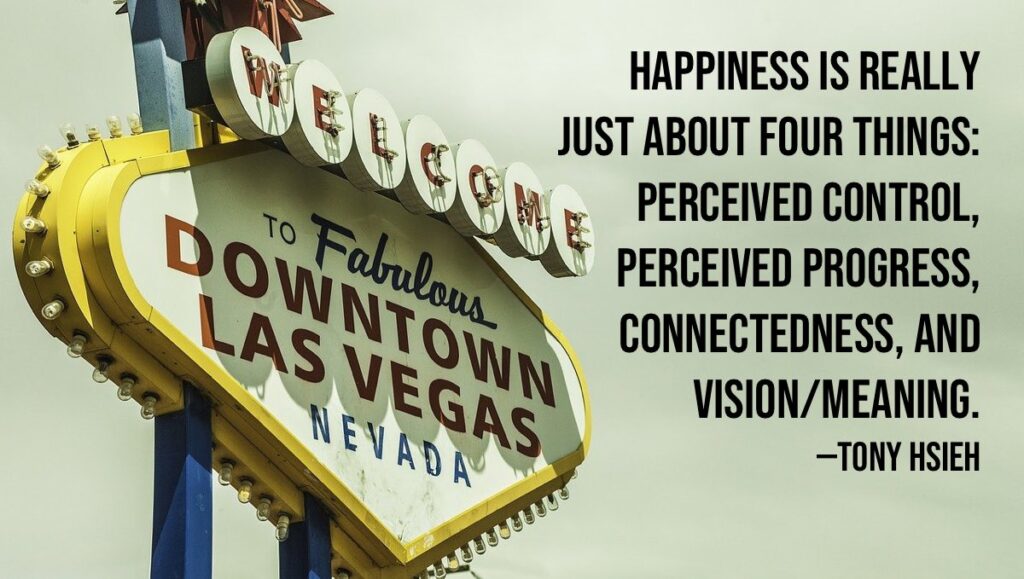
Like many people in the business world, I was saddened to hear of the passing of Tony Hsieh last week. Not only did I have a lot of respect for Tony, but I was fortunate to call him a friend.
If you ever met Tony, you’d know he was definitely like the second employee in the story he recounted. Tony saw potential everywhere, not just in businesses, but also in people. Whether it was empowering Zappos employees to pursue their passion projects or listening to an artist friend around a campfire in the yard near his airstream, Tony saw possibility where others would just see half-baked ideas.
Again, it is well that you should often leave off work and take a little relaxation, because, when you come back to it you are a better judge; for sitting too close at work may greatly deceive you. Again, it is good to retire to a distance because the work looks smaller and your eye takes in more of it at a glance and sees more easily the discords or disproportion in the limbs and colours of the objects.Leonardo Da Vinci[1. Leonardo Da Vinci, “Of Judging Your Own Pictures,” The Notebooks of Leonardo Da Vinci Complete, translated by John Paul Richter, 1883.]
When things are busy or stressful, it’s easy to get caught up in the doing and lose perspective. And, when you lose perspective, it’s hard to connect your day-to-day actions with what you desire over the long-term
Here are three ways taking a break can help you achieve long-term success.
Why are we drawn into stories about adventures? What is our fascination with journeys traveled by characters like Harry Potter or Katniss Everdeen or Washington crossing the Delaware or the fabulously named Rough Riders?
Mythology expert Joseph Campbell tells us that these adventures are all part of the hero’s journey—a schema laid out in his ground-breaking book The Hero with a Thousand Faces. The heroic quest predates written language and its primary structure can help guide teams through massive changes. This story structure is all but hardwired into the human brain: We tell stories this way because stories that follow this pattern release transformative psychological power.
When you visualize daily, you align your thoughts and feelings with your vision. This makes it easier to maintain the motivation you need to continue taking the necessary actions.Hal Elrod, The Miracle Morning
Developing a vision creates energy and momentum in a company.
But, that energy usually fades over time. The pressure of the now takes over. The vision becomes something that will happen in the distant future.
The vision loses the power it was designed to have: create a passion to motivate you through anything in service of the better future you want.
Business purpose helps you get through difficult times.
These reflections have dispelled the agitation with which I began my letter, and I feel my heart glow with an enthusiasm which elevates me to heaven; for nothing contributes so much to tranquilize the mind as a steady purpose,—a point on which the soul may fix its intellectual eye.Robert Walton in Mary Shelley’s Frankenstein
Talk of pivoting is popular. But, most companies don’t have a place to pivot from.[1. Eric J. McNulty, “Find your pillar before you pivot,” strategy+business, 2019.]
When a company only chases profits or market share, they only have the whims of the market to anchor their business. And, when those whims change, their anchors get dislodged and they have to scramble for a new spot to give them stability.
It is important that we know where we come from, because if you do not know where you come from, then you don’t know where you are, and if you don’t know where you are, then your don’t know where you’re going. And if you don’t know where you’re going, you’re probably going wrong.Terry Pratchett[1. Terry Pratchett, I Shall Wear Midnight, 2010.]
As humans, we have the tendency to do what we have always done. What we have always done works, to some degree. But, what we have always done is not the best we are capable of being.
Over time, we develop ways of behaving and reacting. These ways are habitual because they served us at some point, in some situation. And, they are often unconscious: it’s just the way we do things. Yet, often these types of behaviors are not suited for the situations we employ them in.
We get caught up in the constant struggle to keep doing, instead of engaging in the practice of consistently becoming better.
Last week, we wrote an in-depth guide to leading during a crisis—how they affect an organization and strategies to get through them. The advice also applies to any business situation involving a major change as, at their core, that’s what crises are: situations of significant change.
One of the keys to navigating a crisis—or a big change—is what organizational psychologist Edgar Schein calls adaptive moves. In Schein’s words:
By calling them “adaptive,” I am emphasizing that they are not solutions to “the problem” but actions intended to improve the situation and elicit more diagnostic data for the planning of the next move. By calling them “moves,” I am again emphasizing that they are small efforts to improve the situation, not grand plans or huge intervention.[1. Edgar H, Schein, Humble Consulting: How to Provide Real Help Faster, 2016.]
And now these three remain: faith, hope and love. But the greatest of these is love.1 Corinthians 13:13
Real leadership is value-driven, based on principles such as humility, accountability, positivity, and love. Here are eight principles for a more humanistic approach to leadership:
Embody Values:Values determine what types of behaviors are in line with your company's purpose that will help you achieve your vision. Values can never be given up. They guide you in good times and in tough times. They determine what you are and what you are not. Living up to your values protects you from cynics.