

09 Feb Metrics Don’t Always Matter
You can’t manage what you can’t measure.W. Edwards Deming
Businesses have become obsessed with metrics. More metrics are treated as producing greater the results. And, the better the metrics, the better the results.
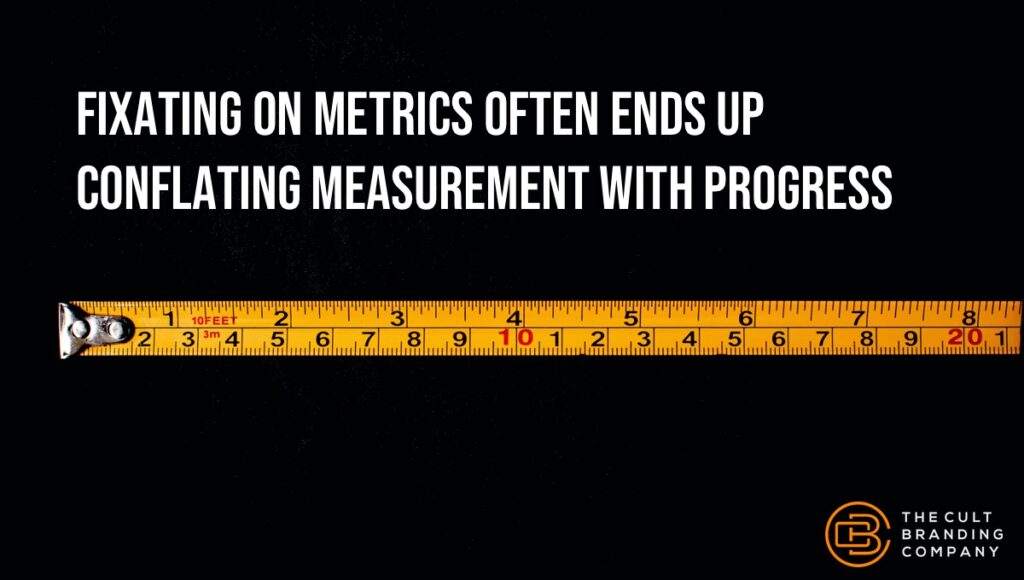
This metric fixation is the byproduct of an unhealthy obsession with outcomes—the movement of a nonexistent needle—that ends up conflating measurement with progress.
To serve the desired outcome, metrics often become as manipulated as the quote that opened this blog: one of the most widely used quotes in favor of the metric mentality was never written by Deming. In fact, Deming wrote quite the opposite: “It is wrong to suppose that if you can’t measure it, you can’t manage it—a costly myth.”[1. W. Edwards Deming, The New Economics for Industry, Government, and Education, 1993.]
It’s not that metrics aren’t important. The problem occurs when businesses obsess about outcomes.
This outcome obsession has resulted in measuring the what and often ignoring the why and how. As Deming writes, “A numerical goal accomplishes nothing….What counts is the method—by what method?…If you can accomplish a goal without a method, then why were you not doing it last year?”[2. Ibid.]
Outcomes are byproducts of methods operating in complex systems. An improved outcome doesn’t necessarily indicate that the complex system is functioning. By just looking at an outcome, a broken system could appear to be functioning properly.
Without understanding the why and how, disaster can be lurking around the corner or a business may not be actually taking full advantage of its potential capabilities. The systems and methods that produce the outcomes are what really need to be evaluated quantitatively and qualitatively, not just the outcomes.
An evaluation must look at the whole picture rather than an arbitrary outcome—much less a single outcome.
Are you paying too much attention to the outcome and not the systems and methods?
_______________________