

21 Dec Authentic Branding:
How to Create a Brand Customers and Employees Love
While revolution must be led from the top, it rarely starts at the top. The spirit of revolution already exists in the hearts and minds of motivated employees and loyal customers. It shows up in the individual stories that employees tell about the work they do. And it shows up in the individual stories that customers tell about the products they love. Often a leader need only act as a kind of managing editor, shaping the stories to align with a shared vision.Marty Neumeier[1. Marty Neumeier, The Designful Company: How to Build a Culture of Nonstop Innovation, 2008.]
Despite what many agencies still claim, brands aren’t logos or taglines and they can’t be made or changed with a single ad campaign.
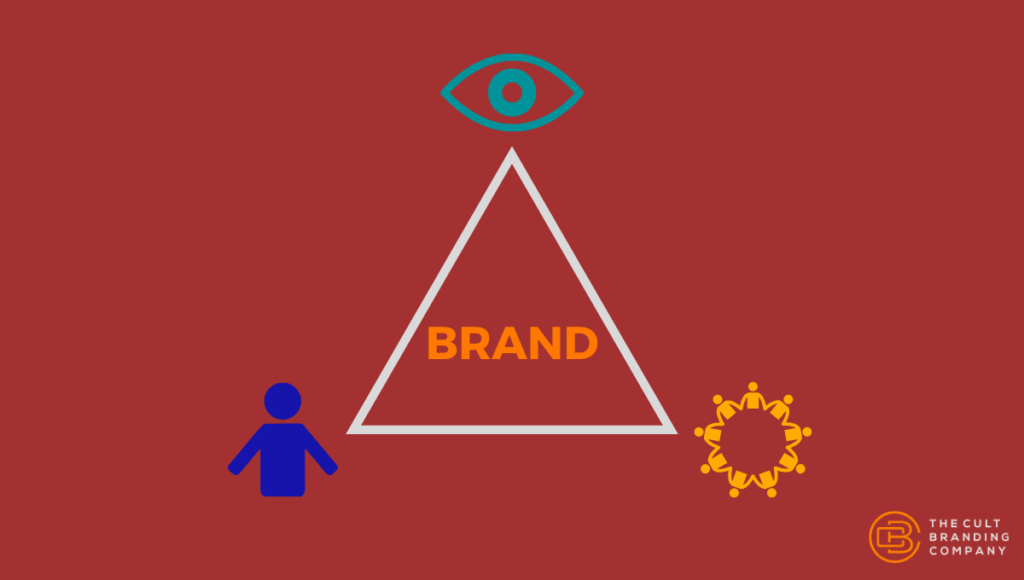
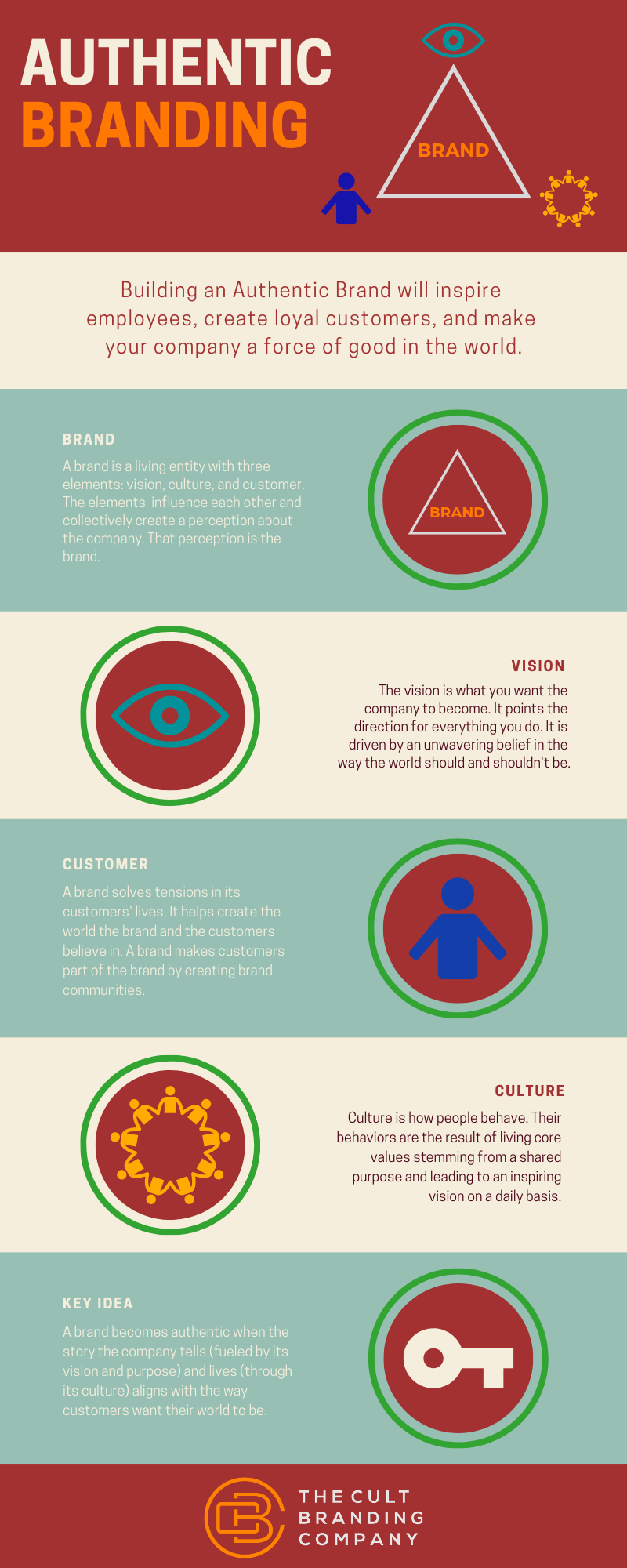
A brand is a living entity with three elements: vision, culture, and customer. These elements influence each other and collectively create a perception about the company. That perception is the brand.
There’s more than one way to create a brand. But, we think there’s only one way to create a brand that will be relevant now and in the future. And, that’s creating an Authentic Brand.
An Authentic Brand isn’t fundamentally different from a Cult Brand: You can’t be a Cult Brand without being an Authentic Brand. Creating an Authentic Brand is a prerequisite for rabid fandom.
So, what makes a brand authentic? Simply, a brand becomes authentic when a company’s purpose resonates with the customers’ and employees’ values.
The identity of a brand is constructed much in the same way that an individual constructs their own identity: with both internally-determined (the vision) and socially-determined (the customer and the culture) elements.[2. Erik Erikson, The Life Cycle Completed, 1982.]
In creating this identity, the brand is the product of one of the most fundamental characteristics of humanity: storytelling. The brand is created through the stories the company, the customers, and the employees tell.
The Stories We Tell
The answer is always in the entire story, not a piece of it.Jim Harrison[3. Jim Harrison, “First Person Female,” The New York Times Magazine, 1999.]
All stories are about survival.
Humans tell stories to provide information about how to navigate situations they’ve never encountered before. Stories tell us how to behave in order to succeed in uncharted territory.
Central to a story is a conflict that the hero triumphs over that creates a change in their life. In the case of a brand, the hero is the customer, the conflict is some tension in their life, and the company—motivated by its vision and powered by its culture—guides the customer through the conflict.
Everything a company does—whether a mailer, a social media post, a super bowl ad, or the way managers treat employees—contributes to the story that the company tells its customers and employees. This story contributes to the perception of the brand.
But, the brand isn’t created by a single narrative. It’s composed of a saga of stories told by the company, customers, and employees.
When a customer tells a story about a $20 shirt, it isn’t just a story about a shirt: it’s a story a mom tells about how she was able to dress her son for prom, how great he looked, how much he beamed, and how much pride she has in the man he’s become.
Or, it can just as easily be a story about how a shirt fell apart, how it ruined her son’s prom, how sad she was for letting him down, and how much a store she trusted let her down by failing to live up to what she believed it stood for.
Employees can tell stories about how motivated they are by their work. Or, they can talk about how the company doesn’t care about them and the dread they feel going to work for their condescending manager who is lazy and just doesn’t get them. And, they just might take that out on a customer.
All these stories—the ones told by the company, the customers, and the employees—contribute to creating a perception.
That perception is the brand.
Although you don’t get to finish the story, you do get to start it. It’s the company’s vision that allows all of the stories to be told: it sets the playing field and the intent. The vision sets the boundaries of what can happen.
And, that’s where we’ll begin.
Vision
When you know what you stand for, you have absolute clarity about the reason you’re the best choice for the people you want to serve—and so do they.Bernadette Jiwa[4. Bernadette Jiwa, Story Driven: You Don’t Need to Compete When You Know Who You Are, 2018.]
The vision is what you want the company to become. It points the direction for everything you do.
A strong vision gives you clarity.
Creating a strong vision isn’t easy. In a market that values short-term results, many companies waver in the face of adversity and choose to create a vision that ends up being nothing more than words on a paper.
Instead of focusing on the future, these short-sighted companies focus on what they’re doing now instead of where they want to be. Without focusing on what you want to become in the distant future, lasting growth and success become hard.
What a company wants to become has to be driven by a purpose: something the company stands for that will always motivate all decisions. This purpose should be centered on something the company firmly believes about the world: the world should be this way and not that way.
A purpose creates a shared goal.
This belief in the way the world should be is a company’s central value. It influences all the core values and is the fire that fuels the vision.
In creating this central value, it’s important to note that the central value isn’t only the way the world should be; it also takes into account the way the world shouldn’t be. A true value needs an opposite it stands against: without a possible negative outcome, there is no tension. And, without any tension to be solved, the value has little motivating force.
The company vision is how you want to ultimately influence the world with your purpose. Anything that doesn’t reinforce a dimension of this vision—anything that doesn’t push the company closer to the vision—isn’t a choice that will benefit the company in the long term.
The vision isn’t just about the company; it’s also about how the company can guide others to overcome the tensions in their lives that the brand stands against. The company is the guide that has the secret mojo.
Without this vision, it’s impossible to attract passionate customers and employees because your brand has no chance of making them feel that the brand aligns with something inside of themselves—the essence of an Authentic Brand.
It’s the vision and the way a company tries to fulfill it—or falls short of fulfilling what it promises —that determines the ways the customers and the employees make their contributions to the identity of the brand.
Culture
But happiness cannot be pursued; it must ensue. One must have a reason to “be happy.” Once the reason is found, however, one becomes happy automatically. As we see, a human being is not one in pursuit of happiness but rather in search of a reason to become happy, last but not least, through actualizing the potential inherent and dormant in a given situation.Viktor Frankl[5. Viktor Frankl, Man’s Search for Meaning, 1946.]
At the heart of a company’s culture are its core values. Core values are a set of values that stem from the company’s purpose—it’s central value—and influence daily behavior in a way that moves the company closer to its vision.
It’s become vogue to hire consultants to help create a set of core values to create an empowered culture. But, after a few weeks, these core values often fall short of having the intended effect. And, after months, they end up becoming little more than a poster on the wall of the office or an occasional email reminder to live the values.
The reason core values often fail is that they aren’t linked to behaviors. A value is a mix of purpose and behavior. Without a strong purpose or continually reinforced behaviors, they will inevitably be ineffective.
This is why company cultures struggle: a culture is how people behave.
To create a strong culture, each core value must stem from a purpose people believe, result in specific behaviors that are reinforced on a daily basis, and lead to a vision that inspires them. These behaviors must point the path from where the company is now to where they want to go. In other words, the behaviors are imbued with purpose.
These behaviors aren’t grand gestures: they’re the everyday repetitions that point towards the shared goal. They are concrete behaviors and not some abstract ideal. They tell people why they’re working and where they’re trying to go
And, these behaviors must start at the top. Cultures aren’t just a way to make lower level employees behave. They’re a way to empower and motivate every person in an organization.
The vision sets what type of culture can exist. The culture influences progress toward the vision.
If the core values don’t result in specific behaviors, the culture becomes broken, and achieving the vision becomes impossible: the vision and the culture become misaligned, creating a dysfunctional culture, and, ultimately, turn progress into stagnation—or worse, regression.
The culture also influences the customer. The culture is like the brand’s personality and character. Employees in a dysfunctional culture will be more likely to treat customers poorly. And, in the increasingly transparent business environment, it’s easy for a customer to tell—via its experience of the culture—if the company is telling the truth about what it stands for.
The culture tells customers how real the company is.
Customer
I’ve said it ad nauseam: the best way to reach out to a community is to become part of a community.Gary Vaynerchuk[6. Gary Vaynerchuk, Crushing It!: How Great Entrepreneurs Build Their Business and Influence—and How You Can, Too, 2018.]
Too often, companies treat customers as statistics instead of people.[7. Stanley Marcus, Quest for the Best, 1979.] By doing this, they treat customers as something to be sold to, instead of treating them as a critical human element of the brand.
If you don’t understand your customers’ needs, you’re going to be telling a story that will never resonate the way you want it to.
Understanding the customer can be tricky for most organizations, because the customers are the element of the brand that’s furthest removed from the company.
For a company to understand its customers, it must understand what motivates them in the context of the tensions in their lives that the brand can solve.
This is often easier for a company starting out than a company that has been in business for a while. The company starting out is more likely to be deeply connected to a purpose that attracts a certain type of customer. Over time, that focus usually becomes diluted.
The most effective way to understand the customer, create customer loyalty, and have them take their true place as a vital element of the brand is to:
- Evaluate what human needs your company primarily fulfills
- Determine what archetypes these needs manifest themselves in
- Translate these human needs and archetypes into customer values
- Create a brand community.
Human Needs
[I]f higher needs are seen to be instinctoid in character, and if culture is seen as more, not less, powerful than instinctoid impulses, and if man’s basic needs turn out to be good and not bad, then the improvement of man’s nature may come about via fostering of instinctoid tendencies as well as through fostering social improvements.Abraham H. Maslow[8. Abraham H. Maslow, Motivation and Personality, 1954.]
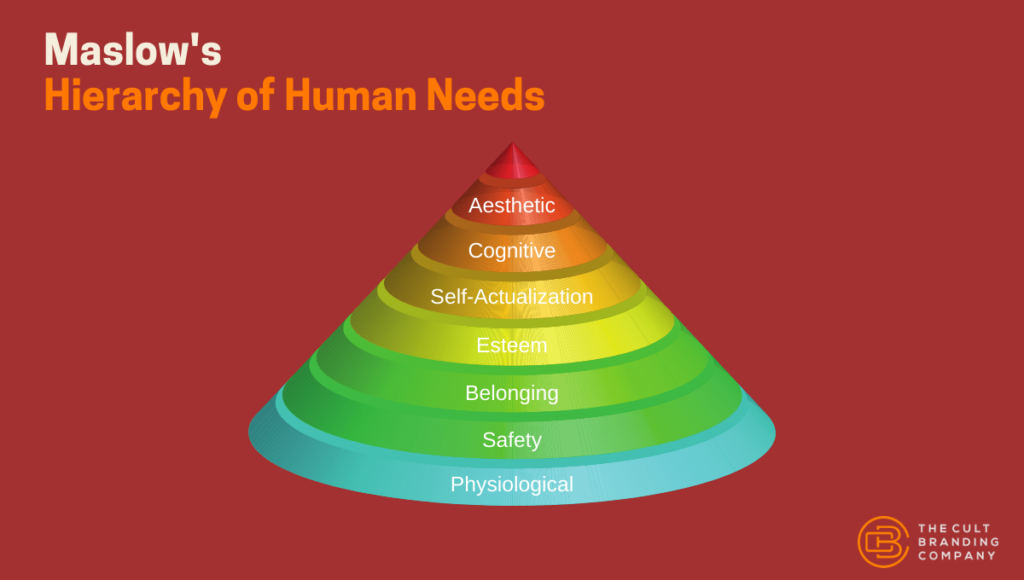
Maslow saw human needs existing in hierarchical form: physiological, safety, belonging, esteem, cognitive, aesthetic, and self-actualization.[9. Many businesses use Maslow’s earlier hierarchy that does not include cognitive or aesthetic needs. Including cognitive and aesthetic needs is valuable, as it adds extra dimensions to brands. We do, however, omit the need for self-transcendence that Maslow put at the top of his later pyramid because we haven’t encountered a brand that can fulfill it.]
No brand fulfills all of the needs equally. You have to evaluate what needs your company excels at helping your customers fulfill.
These should in some way be related to the tensions your purpose drives you to solve. In other words, by solving a tension you help the customer fulfill a related need.
Archetypes
Psychologically…the archetype as an image of instinct is a spiritual goal toward which the whole nature of man strives; it is the sea to which all rivers wend their way, the prize which the hero wrests from the fight with the dragon.Carl Jung[10. C.G. Jung, “On the Nature of the Psyche,” The Collected Works of Carl Jung, Vol. 8: The Structure and Dynamics of the Psyche, translated by R.F.C. Hull, 1960.]
The biological needs Maslow describes act like instincts. These human needs express themselves as images in the psyche. These images are what Carl Jung referred to as archetypes, or as he put it, “archetypes are simply the forms which the instincts assume.”[11. C.G. Jung, “The Structure of the Psyche,” The Collected Works of Carl Jung, Vol. 8: The Structure and Dynamics of the Psyche, translated by R.F.C. Hull, 1960.]
In the business context, a company will fulfill a person’s needs according to a very specific pattern.
For example, Nike taps into the esteem needs—specifically the need for dominance—and this need manifests itself in the archetype of the warrior. The warrior is a psychological construct that customers identify with and that connects back to their instinctual needs.
Determining their archetypes is an area where many businesses fail. They take a cookie-cutter approach: they use a narrow range of archetypes to decide which one represents their business. Restricting the available archetypes to a narrow range is ineffective, because, as Jung noted, “[t]here are as many archetypes as there are typical situations in life.”[12. C.G. Jung, “The Concept of the Collective Unconscious,” The Collected Works of Carl Jung, Vol. 9, Part I: The Archetypes of the Collective Unconscious, translated by R.F.C. Hull, 1959.]
To determine your archetypes, you need to begin by thinking about what category of human experience your brand relates to and what archetypes exist within that category. From there, you can determine which archetypes best represent your brand and the needs you fulfill.
Customer Values
Because a well-told story wraps its telling around emotionally charged values, its meaning becomes marked in our memory.Robert McKee and Thomas Gerace[13. Robert McKee and Thomas Gerace Storynomics: Story-Driven Marketing in the Post-Advertising World, 2018.]
The best way to actualize the archetypes and human needs is to create a set of customer values.
Many companies make the mistake of assuming that their core values and customer values are the same. But, this isn’t necessarily the case. Core values should link to customer values—they’re both fueled by the same purpose—but they may not be identical.
For example, a customer may not care whether a company is “passionate about design.” But the customer will care that the product—created through the company’s passion for design—made their home look beautiful, fulfilling their aesthetic needs.
Core values allow a company to help customers actualize their own values. By solving the customer’s tensions, the company helps customers fulfill their own internal values and creates an emotional reaction in the customer.
Figuring out customer values is key for creating ads and products that resonate with customers. Ads and products that fall flat ignore that they’re solving tensions linked to values.
Just like creating values that lead to behaviors is key to creating a strong internal culture, creating values stemming from the human needs and archetypes that lead to meaningful behaviors for your customers is key to creating customer loyalty.
Brand Communities
Communities are built, person by person, through thoughtful design and authentic, energetic connection points.Radha Agrawal[14. Radha Agrawal, Belong: Find Your People, Create Community, and Live a More Connected Life, 2018.]
When we treat customers as something separate from the brand, the brand can never be as powerful as it has the potential to be. Put simply: how can the economic engine of a company—the customers—fully power the enterprise if it exists separate from it?
Since a customer is an essential element of a brand, treating them as separate from a brand is like getting rid of an essential department in the organization.
The key to treating customers as part of the brand is by creating brand communities. If a person finds meaning in a brand, it is only natural that the brand fosters a relationship with the customer and brings like-minded people together. This also maximizes the brand’s value by fulfilling the need for belonging.
Through interacting with others, people further develop a sense of themselves, via the social element of identity construction. And, when the brand fosters this relationship, customers develop a stronger connection to the brand. This is one of the pillars of Cult Branding
A brand community has three attributes:
- Shared Consciousness: the connection customers have with the brand—via the brand believing the world should be the same way they do—and other customers with the same beliefs
- Rituals and Traditions: the behaviors that mark someone as part of a group
- Moral Responsibility: the desire to help people with the same values and the community as a whole.[15. Albert M. Muniz and Thomas C. O’Guinn, “Brand Community,” Journal of Consumer Research, 2001.]
Creating a brand driven by a strong vision and purpose helps create a shared consciousness. The essential step from there is the creation of rituals and traditions: people don’t become friends only because of shared interests; participating in activities together and creating shared behaviors is what creates a strong bond.[16. Carol Werner and Pat Parmelee, “Similarity of activity preferences among friends: Those who play together stay together,” Social Psychology Quarterly, 1979.] These behaviors can arise either via encouraging and spotlighting existing customer behavior or creating behaviors that tie back to customer values.
By creating these behaviors, customers will develop a responsibility to each other and the community. Ultimately, this creates loyalty towards the brand.
Authenticity: The Battle for Meaning
This same process plays out in every personal decision and economic purchase people make. The perception of authenticity remains personally determined, not corporately declared. You cannot assume that customers will see authenticity the same way you do. You must reach inside them to match your offerings (“I like that”) with their self-image (“I’m like that”).James H. Gilmore and B. Joseph Pine II[17. James H. Gilmore and B. Joseph Pine II, Authenticity: What Consumers Really Want, 2007.]
People wouldn’t care if 77% of brands out there disappeared.[17. Havas Group, Meaningful Brands, 2019.]
This is a disturbing statistic: most brands don’t matter to their customers.
The positive flip side is that the brands that put in the effort to matter will have a huge competitive advantage.
The problem is that too many companies still operate from the standpoint of positioning being king. Positioning was revolutionary for its time. But, it came from a time when companies could tell an audience what to think.[19. Having a position as part of a strategy is still useful, but the tactical execution is different.]
Creating meaning through an Authentic Brand will trump positioning, every time.
Creating meaning is about matching what you think with what customers already think about some part of their lives.
Companies win by creating brands that matter.
And, brands matter—they become authentic—when the story the company tells (fueled by its vision and purpose) and lives (through its culture) aligns with the way the customers want their world to be.
As Robert McKee and Thomas Grace write in Storynomics, “Consumers find a brand trustworthy and meaningful when two stories match: the story the brand tells about itself and the story the public tells about the brand.”[20. Robert McKee and Thomas Gerace Storynomics: Story-Driven Marketing in the Post-Advertising World, 2018.]
Building a strong, lasting brand—an Authentic Brand or even a Cult Brand—is driven by values. Companies that develop an Authentic Brand will have an unwavering vision, develop a strong purpose-driven culture, and help customers become better versions of themselves—solving their tensions and making them part of brand communities.
Not only will these companies succeed, but they’ll be amazing brands to be a part of, whether you’re an owner, employee or customer.
Create a Legacy, Be a Force for Change
I might get shot if some of my friends heard me say this, but businesspeople probably have the greatest potential to transform the world for the better.Timothy Leary[21. Chip Conley Peak: How Great Companies Get Their Mojo from Maslow]
At The Cult Branding Company, we are driven to create a world where companies are a force for positive change. We do this by helping companies create brands that their customers and employees love.
Creating an Authentic Brand is hard. It’s not for every company. If you’re driven by short-term profits—a strategy the market sadly encourages—creating an Authentic Brand isn’t for you: the effort will never pay off because your actions will always be driven by something other than purpose; and, it will be obvious to customers and employees.
Short-term goals may make a business succeed now, perhaps more than its competitors. They may lead to retiring young and big compensation packages. But in the long run, an Authentic Brand will beat brands with only short-term, monetary goals.
It may not be today. It may not be tomorrow. But, it will eventually happen.
People that will be successful in creating Authentic Brands will be those that want to create a legacy: to mean something in the world over the long-term and leave the world better off than they found it.
If you want to create a legacy, if you want to create something bigger than yourself, there isn’t a better way to do it than creating an Authentic Brand.
Authentic Brands will help make their customers’ and employees’ lives better.
It won’t be an easy journey: sometimes just being who you are is the hardest thing to do.
You’ll need a strong purpose to get you through it.
But, it will be a journey you, employees, and customers will be proud of.
_______________________