
31 Aug Embrace Discomfort, Create Change
Growth was seen as an endless series of daily choices and decisions in each of which one can choose to go back toward safety or forward toward growth. Growth must be chosen again and again; fear must be overcome again and again.Abraham H. Maslow[1. Abraham H. Maslow, The Psychology of Science: A Reconnaissance, 1966.]
If you’re comfortable, you’re not growing. It’s the uncomfortable things that make us grow.
The same is true of business: companies that embrace discomfort as a regular part of business life are more likely to achieve their goals and move closer and closer to fulfilling their company vision than those that don’t.
Companies that stay comfortable—which feels great in the moment—end up losing in the long run, which doesn’t feel so great.
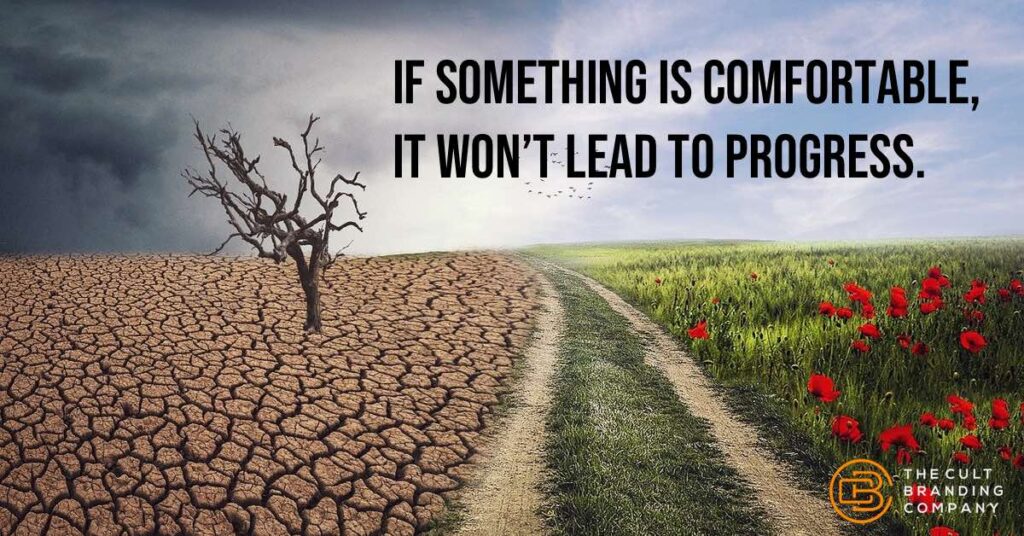
Discomfort is a prerequisite for change.
If something is comfortable, it won’t lead to progress. It won’t even let you retain your current position. This is because stasis doesn’t exist: organizations that embrace discomfort keep moving forward, increasing the distance between them and their static competitors. By standing still, static competitors keep falling further behind. This is what happened to many big-box retailers like Sears and JCPenney.
Although some personal factors, like fear of failure, hinder companies from embracing discomfort as a natural part of successful business, the barrier is mainly an organizational issue: most organizations unknowingly employ processes that embrace the status quo rather than create radical change. The only reason they aren’t falling behind is that many of the competitors have created the same organizational environment.
These companies overwhelm their employees with so many tasks that the employees have little time to focus on the things that matter—things that can be game-changers for the company.
Although lack of time is a contributing factor, it’s not the biggest issue. The big issue is that this overload drains people’s energy. And, that’s a problem because people have a limited amount of energy each day. When employees eventually get through enough of their tasks to tackle the important things—by that time it’s usually toward the end of the day—they only have a little amount of energy left. Low energy doesn’t result in people embracing the type of discomfort that creates change. Instead, it makes them embrace comfortable things that use less energy. So, they’ll either:
- Tackle easy problems and put the big one-off to another day—ultimately spending not only less energy on it but also less time than they should.
- Attack the big problems with default practices—applying comfortable methods that worked before—rather than trying to solve the problem the best way possible.
When energy is low, discomfort is unlikely to be embraced and, therefore, change is unlikely to happen.
Great organizations ensure their people have the energy to embrace discomfort and create change.
Here are three strategies you can use to help your organization move towards creating an environment that embraces discomfort and enables people to create change.
1. Only Have Essential Meetings
It’s rare to find a business person that doesn’t complain about meetings. It’s obvious why: they sap time and energy. Too often, businesses approach meetings as if modern technology never developed. It’s as if they never bothered to update their operating system and are still using an antiquated Meetings app that was developed when meetings were the only way to share ideas and get things done.
Meetings aren’t always the best way to communicate. If you just need to convey information, a meeting is not the best solution. Use email instead. Writing out the email may take more of your time than scheduling a meeting, but, overall, it will save more time for more people.
Only have meetings when nothing else will come close to producing the results, like when you need to solve a big problem or getting buy-in for a major change.
2. Narrow People’s Duties
It’s tempting to give more tasks to motivated high performers: they’ll get everything done. But, getting things done doesn’t equate to getting results. Even though they may get all their tasks done, they won’t be able to give the important tasks the energy they need.
It’s better to have a person focus their energy on the things that can change the game rather than giving them more tasks.
The easiest way to do this is by eliminating tasks that don’t need to get done. Most companies execute more tactics than they should: a large portion of their tactics doesn’t really contribute to the overall strategy. Consider the strategy and how it contributes to achieving your company’s vision. Cut all the tactics that don’t push the strategy toward that goal.
3. Allow Time for Focus.
People should focus on projects when they are the most productive. People have more energy earlier in the day, but too often they’re plagued with meetings and tasks that need to be done “right now.” This approach results in them having to allocate time to the essential things late in the day when their energy is the lowest. Allow people to set blocks of time where their productivity is high to work on the big problems. And, never interrupt that time with anything else.
Keep moving onward.
_______________________